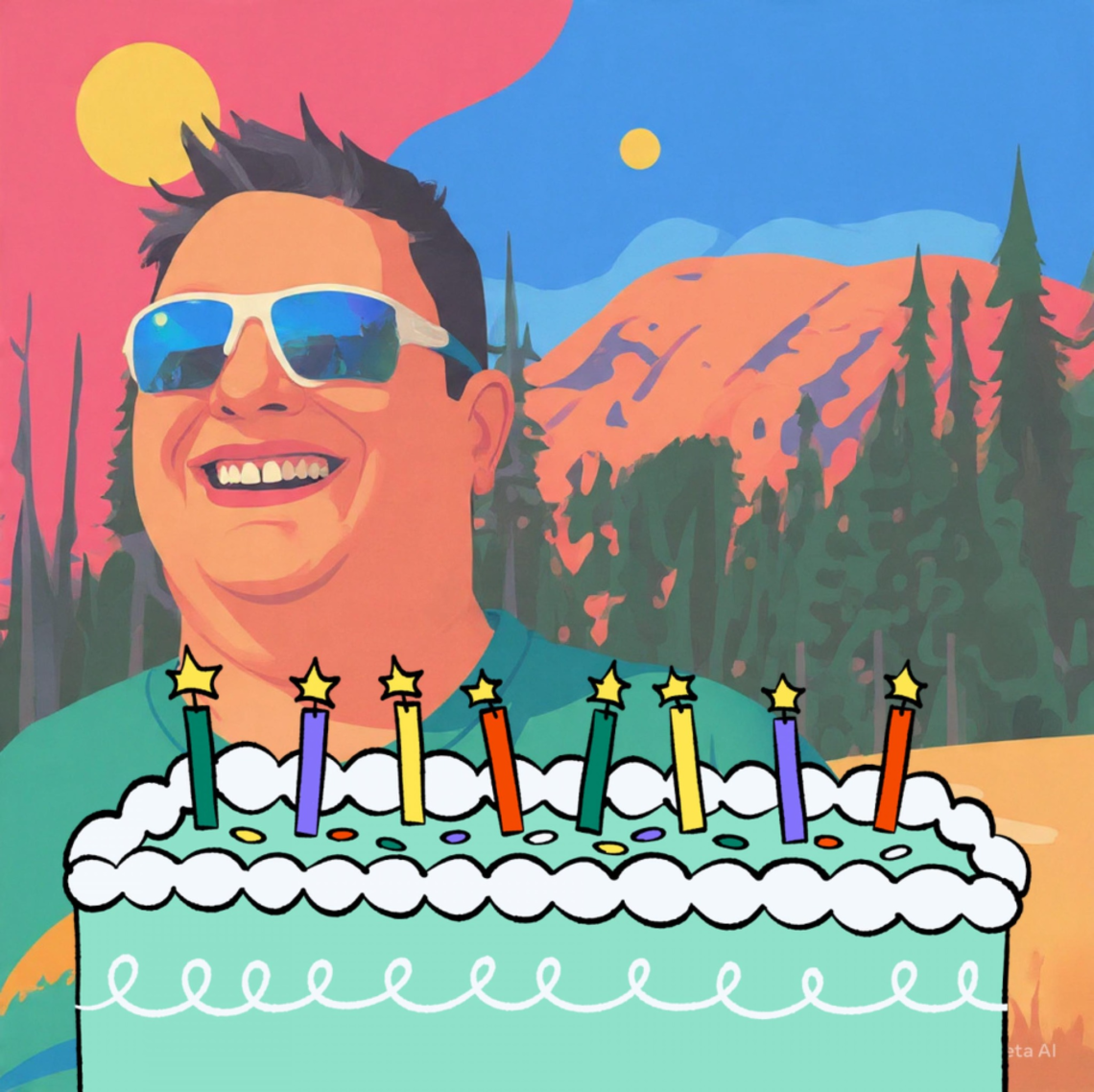
Good Morning! You Have Now Lived Half a Century
When I was in my early 30’s, I was teaching an advanced research class at Burlington College, in Burlington, Vermont, and I mentioned that I had started writing a novel. Of course, they asked what it was about, so I gave them a little synopsis, and I was pretty flattered that they cared so much. It seemed like a good sign to me. One of the students made a shocked sort of face, and I was like, “What?”
He said, “Oh, nothing, I’m just surprised you’re still writing when you’re so late in life. Good for you!”
Naturally, that student subsequently failed the class.
[kidding, of course]
That conversation, which later became fodder for many a banter/blackmail session for me and said student, was the first thing that popped into my mind when I woke up this morning, the morning of my 50th birthday.
My next thought was, Am I too late in life [to start writing]?
Many of you will find that thought ridiculous, but I bet there’s more than one of you out there who can relate. Now, if someone else asked me that question about themselves, I would give them a hearty, No way! That’s ridiculous! But somehow, for me, it applies.
Of course, the way I phrased it above, it’s a moot question anyway, because we’ve already established that I’m not starting to write today. I’ve been writing for…well, almost my whole life. What I was really thinking was, Am I too late in life to continue to pursue this childhood dream of publishing? And, of course, its companion: What if I just don’t have what it takes?
And, luckily for me, this was one of the days where I won my ongoing psychological battle, and my next thought was, Well…I’ve got a way better chance now than when I was in my 30’s. Which brought me to this:
7 Things I Know Now That I Didn’t Know Then
1. Writing is a Practice
Sure, writing is fun, because telling stories is fun. People love stories, and I have always loved giving the people what they want. But creating a story world for a reader is not easy. Evoking just the right emotion, at just the right time, so the reader will understand and truly feel what you want them to? That’s hard. That’s work. Writers work. I thought I knew this in my early years. After all, I’d seen my mom “do the work” every day, and she didn’t always have a smile on her face. But I didn’t actually understand until I thought about it another way: in order to do the work, it takes practice. Like anything else, you have to put in those 10,000 hours in order to internalize the mechanisms that make it possible for your brain to create.
You can be creative; you can have raw talent; you can be smart or good with words. These are the things people say about “successful” writers [read: published]. All of those qualities are great, and at times even helpful. But all of those naturally talented people still have to practice. They have to sit down at their desk, or wherever their space is, and put words on a page, whether they feel inspired or not. And they have to keep doing that, day after day. Some of those days are filled with hope and exhilaration and perhaps inspiration. But most of those days are filled with a sense of doing the work, of practice. It’s very simple: when you do the work, you get better.
2. You Really Can Write to Discover
I tell my students that there are three reasons we write: to express, to process, and to discover. They’re iffy on the second thing (mostly because they don’t believe in processing – only producing), but getting them to believe in the magic of writing to discover was a task for Sisyphus. Until their writing led them to something they didn’t even realize was in their head. Then they would stop writing and look up at me with big, saucer eyes that said, Whoah! So, you’re thinking, wait, then this doesn’t count as something you “didn’t know then.” I’d agree with you, except that as many times as I’d seen that happen – and even experienced it for myself – I didn’t feel it in quite the same way as I have in the last 5 years or so.
I’ve found that as you get older, you get more introspective. You want to understand things better: your past, your personality, who and what have made you who you are, and where all that might show up in your life in the present and future. One way to learn all that is to write about it. And when I did that – when I wrote about all the thoughts and wonderings I had in my head – I discovered parts of myself I had no idea were there, some parts that had been hiding for decades, some that I think were recently formed and just hadn’t made themselves known yet. Suddenly my stories, both fictional and personal, opened up. Doors appeared where there had been none; characters showed me new dimensions; settings added tiny details that totally shifted the plot or theme. My work in better understanding myself uncovered depths in my stories that I didn’t even know existed. I was brave enough (or crazy enough) to face my own demons, and I got to know myself a hell of a lot better. And that all made my writing a hell of a lot richer.
3. Authenticity is the Key to Depth
There are so many theories about the best way to get published out there. And since I haven’t been published [yet], I’m not going to join in that conversation [yet]. But I do endorse authenticity. I’ve never had a problem with authenticity in my normal, everyday life. In fact, many people tell me that I’m the most honest, authentic person they’ve known. I take that as a compliment, even though I know people don’t always appreciate directness. And yes, sometimes I’m honest to a fault. So, you’d think I wouldn’t have a problem with it in my writing. But I used to approach my stories and novels by thinking, what do people want to read? What do agents, editors, and publishers want to see? Those thoughts would immediately lead me to thoughts like, this idea is stupid. No one’s going to want to read this!
Then, somewhere around age 43-45, something changed. I simply stopped caring what other people would want to read. I started writing things that I wanted to read. Sometimes I had a half-formed idea, and I would just go for it on the page, and it wouldn’t work out. But I didn’t punish myself for it; I just thought, oh well, on to the next idea. I think I was able to make that shift because I was no longer worried about whether someone in the industry would like it or not. Ultimately, I took the late, great Toni Morrison’s advice: “If there’s a book that you want to read, but it hasn’t been written yet, then you must write it.” Now my writing has all the authenticity I bring to every situation. That doesn’t mean I’m not willing to take feedback [see #5] or make changes; it just means I’ve shifted my general purpose from “getting published” to “speaking the truth through story.”
4. Collaboration is Better than Isolation
Everyone is afraid of collaboration. I have come to this conclusion after 26 years of teaching writing, being in “collaborative” groups and meetings, and being myself. With students (novice writers), the “why” is clear: they think everything they write is stupid, boring, or otherwise worthless, and showing it to someone else is akin to torture to them. But I don’t think they’re the only ones who feel that way. And I don’t believe people are afraid of collaboration because they don’t want to work with other people. (OK, maybe there are a handful of those people). I think we are all afraid of ourselves, our own worth. What if people are harsh? What if they think I don’t belong in their group? What if someone has an idea that’s better than mine – then I won’t be the real author anymore? What if they’re just too bored to read all of my writing? All of these questions have run through my mind at many points in my career, just before doing peer editing, or joining a writing group, or participating in a workshop. I’m sure I’m not alone.
But look at them: they all stem from insecurity about my own worth as a writer. It’s not about the other people. (Side note: here’s where assuming best intentions of others could solve some of your doubts). It’s really not even about what they might or might not say or feel. It’s about how I feel about my work in that moment. Once I realized this, I took stock of myself. Here’s what I know: I’m hyper-analytical, and I have anxious/analytical/neurotic thoughts running through my head 24/7; when I spend too much time alone, those thoughts take over and convince me of all kinds of negative core beliefs, especially as they pertain to my art; I enjoy giving others feedback and ideas about their writing, and I’m good at it. Those three truths opened me up to collaboration. I thought, Wait. If I spend some time with others who also want to process through ideas about writing, it will distract me from my intrusive thoughts, give me different ideas to consider, and I’ll probably enjoy myself! To add to that, I remembered I’m a verbal processor. As I’ve leaned more into collaboration in the last 5-10 years, my insecurities (about writing) have greatly lessened, I’ve made new writer friends, and my mind has opened to new possibilities in my writing, even in stories I thought I were “done.”
5. You’re the Author
As a companion concept to #4, there’s this: no matter what anyone says about your writing, suggests for you to change, or marks “wrong” on your paper (for my students), in the end, you are the author. You have the final say. If you want to ignore someone’s advice because you don’t agree, you get to do that. If you want to break up with your agent or editor because you think they’re steering you in the wrong direction, [I think] you can do that. If you want to change your whole plot line mid-way through your 41st draft, you can make that choice. You’re the author. The trick is owning that choice. In our everyday lives, we’re constantly choosing to take or ignore advice. Think about how many times a day someone tells you what they think you should do, even in little ways, and you always make a choice one way or another.
I’m hoping that you don’t hold that Applebee’s waitress accountable when she recommends the Bourbon Street Chicken and you end up hating it. (I know some people do, but my question to them is…why?? Ultimately, you made the choice to try it!). Anyway, it’s no different with collaboration on your art or writing. You’re in a group, they read, you talk, they give feedback, and then you choose whether or not to take it. So, there should be no fear about what they say because no one is putting you in handcuffs. No need to be angry (or hurt, even though that’s harder) or get even. Just go back to your happy place and carry on writing the way you always have. Maybe don’t follow them on social media. But by god, use that Oxford comma to your heart’s content! [#oxfordcommatildeath] You’re the author! Yes, there’s responsibility in this concept, but there’s also freedom. As authors we know nothing is set in stone; you can always change it later; there is no real final draft. There’s only what you, the author, choose to publish (whatever that means in your case). And you always have your reasons.
6. Rejection is Inevitable (but it doesn’t really matter)
Putting your writing “out there” is hard, no question. If you’re someone who’s afraid for others to see your writing because you feel raw, exposed, vulnerable, I feel you. I understand. You’re not alone. I was never like that — I think because I loved writing and stories so much, and I always expected everyone to think like me [this is a problem to unpack at another time], that it never occurred to me that someone would actually reject my stories. [I also like to assume best intentions, which often leads me to trouble in other ways, too]. A few years ago, I started the process of querying agents for my YA novel. I had read somewhere that you shouldn’t despair until you get 80 rejections; then you can start thinking about what to do next. So, I went into the process steeled for the worst. I racked up 25 rejections, and I was fine. I wasn’t crushed, and I didn’t want to give up — quite the opposite, actually. The reason was that within those 25 rejections, I had one agent request my full manuscript; three agents tell me they loved my voice and style and that they were very close to taking me on; and two agents tell me my work wasn’t right for them but that they knew it would be right for another agent, so I should keep going.
Jackpot! But I also got some consistent feedback on my protagonist that made me pause and consider revision. So, I put a pin in querying and went back to the desk. In the end, did I get rejected? Yes. 25 times. But it didn’t feel personal. Even the form letters didn’t hurt. Maybe if the agents had said horrid things about my writing or told me not to quit my day job — that would’ve probably stung. As it was, though, the whole experience felt more like a resounding, “It’s not quite ready yet.” Which, after re-reading with fresh eyes, I realized was accurate. Thus, I learned that getting rejected — especially if you get feedback — is really no different than taking a writing class from an expert professor. Of course, I’ll update this when I hit 80 rejections, and we’ll see if I feel the same way.
7. Just Because It’s Fiction Doesn’t Mean It Isn’t True
I’m sure you’ve heard people say, truth is stranger than fiction. Basically, what that means is that often when you try to write story about something that actually happened, it doesn’t feel right. It’s not believable. Your reader thinks, no way, that would never happen, or similar. And then you’re there like, yeah, but it did! I swear! You should not have to say that to your reader; you should not have to convince your reader that your plot line is believable. That does not make for a good story. It always flops. But there’s a big difference between writing about what happened and writing about the truth, because truth is not the same as fact. When you try to retell an event exactly as it happened, it’s boring. That’s because usually, it’s missing the emotions of the moment, the backstories of the people involved, the inner thoughts of the narrator and the other “characters.” Those are the elements of a story that convey to the reader the truth of the moment.
We also know that the human brain is not capable of recounting an event factually after a couple of hours. By that point, your brain has already started to distort your memories. But that doesn’t mean you can’t speak to the truth of what happened or what you think you saw or heard. Why do you think cops ideally want to speak to multiple witnesses to a crime? Everyone’s testimony will be a little bit different, but they’re looking for the patterns and similarities. They often say the truth is somewhere in the middle. So, there’s a definite gray area when it comes to truth that many people are not willing to admit. But we storytellers (this includes fiction and nonfiction creatives) know a secret: if you open yourself up to the idea that maybe everything has a little fiction and a little truth in it, you’ll discover more truths than you thought were possible.